
Rice Export to Italy from India
Italy is one of the fastest-growing markets in Europe for Indian rice, even though the country itself is Europe’s biggest producer of rice. That may sound like a contradiction, but it isn’t. Italian rice fields around Piedmont and Lombardy grow short and medium grain varieties like Arborio, Carnaroli, and Vialone Nano, the rice used for risotto. Indian basmati and non-basmati rice serve a completely different purpose in the Italian market: aromatic long grain rice for biryani, pilaf, and everyday South Asian, Middle Eastern, and North African cooking, plus a growing Italian audience curious about ethnic cuisine and specialty grains.
Kumud Group has been milling and exporting rice from India since 1994. We run two mills, one in Sandi Chungi, Hardoi, Uttar Pradesh, and one in Village Nariana, Taraori, Karnal, Haryana, which sits in the Indo-Gangetic basmati belt recognized under India’s GI certification. We currently export to more than 30 countries across Asia, the Middle East, and Europe, and this page covers what an Italian importer, distributor, or ethnic grocery buyer needs to know before sourcing rice from us.
1994
Milling Since
30+
Countries Served
1000+
Satisfied Clients
2
Rice Mills
EU Food Safety and Documentation Requirements
Rice entering Italy follows the same EU-wide food safety framework as any other member state, since Italy applies EU regulations directly rather than setting separate national rules for imported food. Every consignment needs a commercial invoice, packing list, bill of lading, and certificate of origin. Depending on the product and the season, a phytosanitary certificate may also be required, since rice is treated as a plant product under EU plant health rules. Labeling has to follow EU Regulation 1169/2011, which means the information on the pack (ingredients, net weight, storage instructions, and origin) needs to be in a language Italian consumers can easily understand. For retail-bound shipments, this usually means Italian text on the label, either alone or alongside English.
If your basmati shipment is meant to qualify for the EU’s preferential duty treatment under Regulation 972/2006, it also needs a Certificate of Authenticity issued by India’s Export Inspection Council. Without this certificate, basmati is taxed like any other long grain rice at the standard EU tariff, so this is not a step to skip.
Pesticide Residue and Quality Checks
The EU has tightened pesticide residue limits on rice over the past several years, most notably lowering the maximum residue level for the fungicide tricyclazole to 0.01 mg/kg back in 2018. Since then, all basmati and non-basmati rice exported from India to the EU needs a Certificate of Inspection from India’s Export Inspection Council confirming the consignment meets these limits. India’s rice has also been on the EU’s list for increased border checks in the past, though as of the January 2026 update to Regulation 2019/1793, rice from India was removed from the list of products facing extra scrutiny for aflatoxin and ochratoxin A, on the back of a consistent compliance record since 2022. This is a positive shift, but border control rules are reviewed periodically, so it’s worth confirming the current status with your customs broker before each shipment.
Our Certifications


Popular Rice Varieties for the Italian Market
1121 Basmati Rice
Long grain, known for its length after cooking, a common choice for bulk food service buyers.
1509 Basmati Rice
Shorter cooking time than traditional basmati, popular with importers who want faster turnaround.
Traditional Basmati Rice
Aged basmati with a stronger aroma, used by buyers who want a premium grade.
Pusa Basmati Rice
A widely grown basmati variety, used across retail and food service.
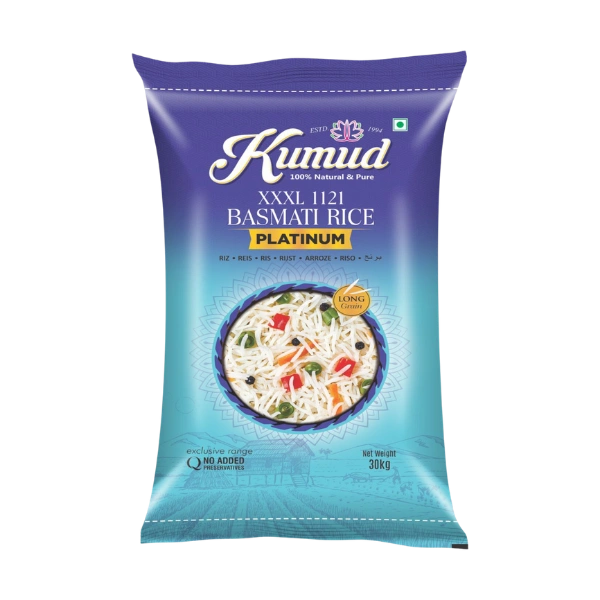
Pesticide Residue Free Rice
For Italy with stricter food safety requirements, we also supply Pesticide Residue Free rice across select basmati varieties. This is tested for pesticide residue limits before it leaves our mill.
Note: Non basmati rice from our range, including Sona Masoori, Idli, Kolam, PR11, PR14 and Black Rice can also be supplied to Italy on request.
Packaging and Shipping to Italy
Packaging Options
We pack rice anywhere from 500g consumer pouches to 50kg bulk bags, so the same order can cover retail shelf packs and wholesale sacks. Custom private label packaging is available if you want your own brand on the bag, useful for supermarkets, ethnic grocery chains, or foodservice distributors who want a consistent look on their shelves. If you go the retail route, remember that Italian-language labeling is a legal requirement, not optional, so factor that into your packaging design timeline.
Shipping and Minimum Order Quantity
Our minimum order quantity starts at 20 to 21 metric tons, which lines up with a standard 20-foot container load. Shipments typically move by sea through major Italian container ports such as Genoa, La Spezia, Livorno, Naples, or Gioia Tauro, depending on where your warehouse or distribution point is located.
FAQs
Q1: Does Kumud Group export rice directly to Italy?
Ans: Yes. We already export to more than 30 countries across Asia, the Middle East, and Europe, and we work with importers, distributors, and private label buyers in Italy.
Q2: What is the minimum order quantity for rice export to Italy?
Ans: Our MOQ starts at 20 to 21 metric tons, roughly one 20-foot container load. We can discuss volumes above that based on your packaging mix.
Q3: Is Kumud Group's rice Halal certified?
Ans: Yes, our rice is Halal certified along with international food safety certification.
Q4: Can we get our own brand on the packaging?
Ans: Yes, we offer custom private label packaging from 500g to 50kg, so you can bring your own branding and Italian-language labeling to market.
Q5: How experienced is Kumud Group in rice export?
Ans: We’ve been milling and exporting rice since 1994, over 30 years, from our two mills in Uttar Pradesh and Haryana, and we’ve worked with 970+ satisfied clients across our export markets.