
Rice Export to Denmark from India
Kumud Group has been growing, milling, and exporting rice from India since 1994. Our two mills sit in Sandi Chungi, Hardoi, Uttar Pradesh, and Village Nariana, Taraori, Karnal, Haryana, which is part of India’s GI-certified basmati belt. Over the past 30 years, we have built our export business on one simple rule: what we would not feed our own family, we will not sell to yours. That rule now reaches 970+ clients and 30+ countries across Asia, the Middle East, and Europe.
Denmark’s rice market runs on two demands at once. Copenhagen, Aarhus, and Odense have growing South Asian, Middle Eastern, and other immigrant communities who want authentic, good-quality basmati for daily cooking and restaurant use. At the same time, Danish retailers and importers work under some of the strictest food safety expectations in Europe. This page covers what Danish importers, wholesalers, and retail buyers need to know before sourcing rice from Kumud Group, from compliance to packaging to shipping.
1994
Milling Since
30+
Countries Served
1000+
Satisfied Clients
2
Rice Mills
Compliance and Import Regulations for Denmark
Denmark is part of the European Union, so rice imports follow EU food law and are enforced locally by the Fødevarestyrelsen, the Danish Veterinary and Food Administration. Any exporter shipping rice into Denmark needs to work within this framework rather than treat it as a separate national system.
EU Food Safety and Residue Rules
Rice entering the EU must stay within the pesticide residue limits set under EU Regulation (EC) No 396/2005, and within contaminant limits, including limits on inorganic arsenic, set under EU Regulation (EC) No 1881/2006 and its later amendments. These limits are reviewed and revised from time to time, so the exact current thresholds should be checked against the latest version of the regulation before this page goes live. Kumud Group also offers a Pesticide Residue Free rice line, which gives Danish buyers an added margin of safety against these limits, on top of standard testing.
Our Certifications






Popular Rice Varieties in the Danish Market
1121 Basmati Rice
Long grain, known for its length after cooking, a common choice for bulk food service buyers.
1509 Basmati Rice
Shorter cooking time than traditional basmati, popular with importers who want faster turnaround.
Traditional Basmati Rice
Aged basmati with a stronger aroma, used by buyers who want a premium grade.
Pusa Basmati Rice
A widely grown basmati variety, used across retail and food service.
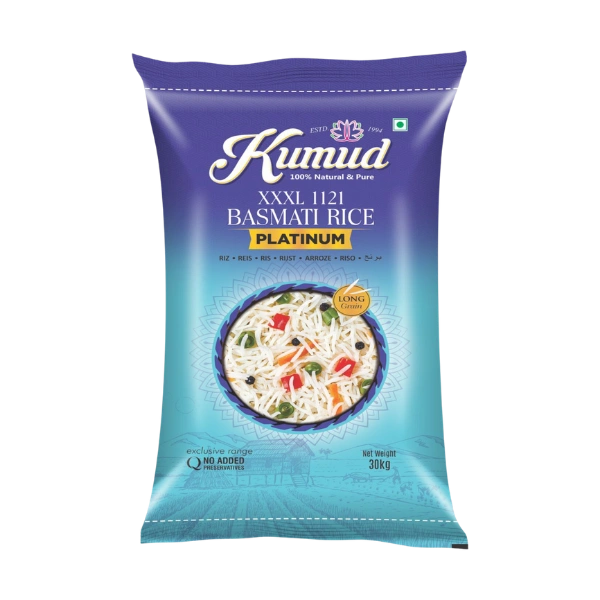
Pesticide Residue Free Rice
For Denmark with stricter food safety requirements, we also supply Pesticide Residue Free rice across select basmati varieties. This is tested for pesticide residue limits before it leaves our mill.
Note: Non basmati rice from our range, including Sona Masoori and Parmal can also be supplied to Denmark on request.
Packaging and Shipping for Denmark
Packaging Options
Kumud Group packs rice from 500g retail pouches up to 50kg bulk bags, and packaging is adjusted to match what a buyer actually needs rather than a fixed set of sizes.
Shipping and Minimum Order Quantity
Orders are handled on a minimum order quantity of 20 to 21 metric tonnes, which is one container load. Shipments typically move from Indian ports such as Nhava Sheva, Mundra, or Kandla toward European ports, either discharging directly at a Danish port such as Copenhagen or Aarhus, or via transshipment through a European hub port.
FAQs
Q1: Does Kumud Group's basmati rice qualify for duty-free import into Denmark?
Ans: Yes, provided the variety is on the EU’s approved basmati list and the shipment carries a valid Certificate of Authenticity from the Export Inspection Council, India. We confirm variety eligibility at the time of order.
Q2: What certifications does Kumud Group hold?
Ans: Our rice is Halal certified and certified to international food safety standards. Full certificate details are shared with buyers on request.
Q3: Can Danish retailers or distributors get their own branded packaging?
Ans: Yes, custom private label packaging is available across our packaging range, from 500g retail packs to 50kg bulk bags.
Q4: Which varieties work best for the Danish market?
Ans: 1121 and 1509 Basmati are the most requested for restaurant and retail biryani and pilaf use. Sona Masoori and Parmal cover everyday non-basmati cooking, and our Pesticide Residue Free rice suits buyers who prioritize residue testing.