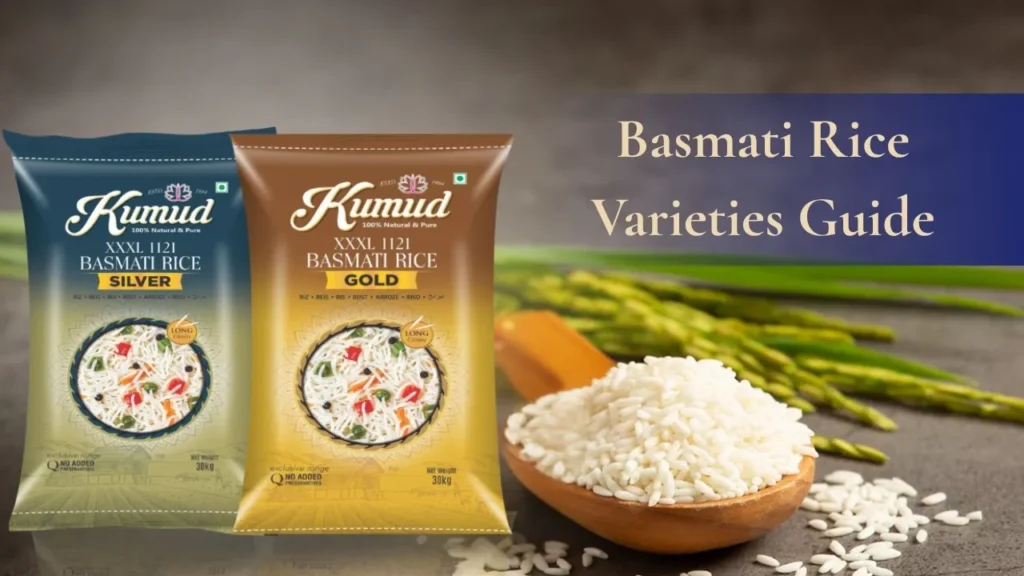
Most people can name one or two types of Basmati rice. The reality is that India has 29 officially notified Basmati varieties each with its own grain length, aroma strength, and cooking behavior. Not all of them are widely traded.
But the ones that have shaped global rice markets, fed millions of households, and built India’s reputation as the world’s largest Basmati exporter. This guide covers every major Basmati rice variety, what makes each one different, where it fits, and how to tell them apart.
What Makes Basmati Rice Unique?
Not every long grain rice is Basmati. What separates Basmati from all other rice comes down to four things:
- GI Tag: Basmati holds a Geographical Indication tag only rice grown in officially notified regions of India and Pakistan can legally carry the name. It is a protected identity, not just a style of rice.
- Aroma: The fragrance comes from a naturally occurring compound called 2-acetyl 1-pyrroline. This compound is present in other aromatic rice too but at much higher concentrations in Basmati.
- Grain elongation: Basmati grains nearly double in length on cooking. No other rice does this consistently.
Texture: Cooked Basmati grains stay fully separate. No clumping, no stickiness.
These four qualities together are what make Basmati genuinely different and why no other rice can legally or practically replace it.
Major Basmati Rice Varieties
India’s commercially traded Basmati varieties all come from the same aromatic family but grain length, aroma intensity, cooking behavior, and price differ significantly from one variety to the next. Here is every major variety explained clearly.
1121 Basmati Rice
1121 is the benchmark premium Basmati variety. Developed by IARI, it has one of the longest raw grains of any commercially traded rice averaging 8.30 to 8.35 mm before cooking. On the plate, the grains elongate dramatically, stay fully separate, and look visually striking.
The aroma is strong and classic. It is the most widely exported Basmati variety from India and the first choice for premium biryani, wedding catering, and hotel kitchens. Best results come from aged stock 12 to 18 months after harvest.
1885 Basmati Rice
1885 was developed as a direct improvement on 1121. Grain length and cooking quality are nearly identical but 1885 offers better resistance to bacterial blight at the farm level, making it more reliable for consistent supply.
Export markets are increasingly accepting 1885 as a high-quality alternative to 1121, often at a slightly lower price. Like 1121, aging is recommended for best elongation and texture.
1718 Basmati Rice
1718 has a long slender grain averaging 7.90 to 8.00 mm. The aroma is strong and the cooked texture is soft and slightly loose which many cooks prefer for certain preparations. It is a popular export variety and a common choice for festive cooking. One important note 1718 can turn slightly sticky if not properly aged. Aging is essential before export.
1847 Basmati Rice
1847 is built on the 1509 base but with two clear improvements a stronger aroma and better disease resistance. The grain is long and slender, and it cooks non-sticky with grains that become longer and thinner on cooking.
It is priced competitively and growing in export acceptance, particularly among buyers who need reliable quality at a lower price point than premium varieties.
1509 Basmati Rice
1509 was introduced to solve a practical problem of faster crop cycles and lower water use. It matures significantly earlier than other varieties, which makes it popular among farmers and bulk buyers. The grain averages 8.10 to 8.20 mm but the aroma is mild to medium, noticeably lower than 1121 or 1718. It has a higher tendency to break and weaker elongation. Best suited for bulk catering, HORECA, and budget biryani where cost efficiency matters more than premium presentation.
1401 Basmati Rice
1401 sits comfortably in the mid-market. The grain averages 7.70 to 7.90 mm, the aroma is medium, and the cooked texture is soft with a slightly moist feel. It does not have the dramatic elongation of 1121 but delivers consistent, satisfying results at a price that works for everyday household use.
Traditional Basmati Rice
Traditional Basmati also called Dehraduni Basmati is the original. Grown in the Dehradun valley of Uttarakhand, it has a shorter grain than modern hybrid varieties, averaging 7.20 to 7.50 mm. What it lacks in length it more than makes up for in aroma. The fragrance is the deepest and richest of all Basmati varieties.
It nearly disappeared as hybrid varieties took over commercial farming but it is making a quiet comeback among those who value authentic fragrance over grain length. Best for traditional home cooking and festive meals where aroma is the whole point.
Pusa Basmati Rice
Pusa Basmati is the most widely available everyday Basmati in Indian households. Developed by IARI, it has a moderate grain length of 7.40 to 7.45 mm and a pleasant but not overpowering aroma. It cooks fluffy with minimal stickiness and delivers consistent results meal after meal — at a price that suits daily use.
Where Is Basmati Grown in India?
Basmati cannot be grown just anywhere. The name is legally protected; only rice grown in officially notified regions of India can carry the Basmati designation.
There are 7 notified states in India:
- Punjab
- Haryana
- Himachal Pradesh
- Uttarakhand
- Uttar Pradesh
- Jammu & Kashmir
- Delhi
The soil, water, and climate of this belt sitting at the foothills of the Himalayas produce the specific conditions that develop Basmati’s characteristic aroma and grain elongation. Rice grown outside these regions, even if it looks similar, cannot legally be called Basmati.
Why Aged Basmati Is Better Than Fresh Crop
Fresh harvest Basmati has higher moisture content. This makes the grain softer, more likely to break during cooking, and less aromatic than it could be. Aging changes all of that. When Basmati is stored for 12 to 24 months after harvest, moisture slowly leaves the grain. The grain hardens, cooks firmer, and elongates better on the plate.
At the same time, the aroma compounds concentrate making the rice noticeably more fragrant than fresh crop.
Think of it like wine. The harvest year matters. A well-aged Basmati from a good harvest will always outperform a fresh crop of the same variety. Premium varieties like 1121 and 1885 are specifically recommended in aged form both for export quality and eating quality.
How Basmati Variety Codes Work
When you see names like 1121, 1509, or 1718, it is easy to assume the higher the number, the better the rice. That is not how it works.
These numbers are identification codes assigned by the Indian Agricultural Research Institute (IARI) in New Delhi. Each code is simply a registration number given to a new variety when it is officially developed and released. The number reflects the order and system of registration — not quality, grain length, or price.
This means:
- 1121 is not superior to 1509 because 1121 is a smaller number.
- 1718 is not better than 1121 because 1718 is a larger number.
- The codes are identifiers, nothing more.
Each variety is judged on its own characteristics: grain length, aroma, elongation, cooking behavior, and yield. The number tells you nothing about any of these. This is one of the most common misunderstandings among first-time rice buyers and now you know better than most.
Conclusion
Basmati is not one rice, it is a family. From the premium elongation of 1121 to the heritage fragrance of Traditional Basmati, every variety has its own identity and its own place. The right variety depends on what you are cooking, who you are serving, and what your budget allows. Now that you know what separates each one, choosing the right Basmati is no longer guesswork.